Originally by Muse, a film cover by Alexandré Zii Miller
What began as me in bed with my Squishmallow plushie
(watching the music video for Sing for Absolution
for the very first time) somehow followed with frostbite
in Warsaw, luggage stranded in Chongqing, detention at
the Russian border, a broken bone, and narrowly missing
a drone strike in Abu Dhabi because a concert Muse was
supposed to play there got cancelled. Here's the rundown
of how it all went down.
Capstone overview
Artist Statement
I set out to make a cover of a song. I finished
realizing the song had been a cover of me.
Alexandré Zii Miller (2026)
Looking at the timeline now, the making of the cover
ended up being the bigger piece. Sing for
Absolution is a song about isolation and pressing
through something you didn't choose, and the conditions
I made it under ended up answering the song more
honestly than I could have if everything had gone
smoothly. The film is the deliverable. The experience
of getting there is what the film turned out to be
about.
The process of singing, the process of writing music and singing music,
can almost be a form of absolution, really.
Dominic Howard, Muse (2003)
That line is the reason this capstone is a film cover and not a programming
project or a research paper. While my classmates leaned toward systems and
studies, Howard's framing of music-making as its own kind of absolution
described something I wanted to actually do, not write about.
I also didn't want this to be another bedroom cover, where
someone whips out a camera and records themselves playing
along to the tracks on a guitar. I wanted to recreate the
song with visuals that represented how I personally feel
every time I hear it. That was the basis for the
short-film treatment.
The project takes the form of a music video built around two
parallel narratives: a warm interior band performance and a
cooler exterior shot on location in Poland during winter. The
same vocalist appears across both worlds, and across multiple
selves within them, as the only performer in the cut with a
fully visible face. The cover preserves the lyrics and
emotional core of the song while reorienting its visual
language toward self-introspection and isolation.
Project goals & success criteria
First, ship a complete cinematic film cover by the
end-of-semester capstone deadline. Halfway through the
project I realized that the song's 22nd
anniversary fell on May 17, 2026, the same week
as the capstone presentation. That coincidence wasn't in
my original proposal at all. Once I caught it the capstone
deadline doubled as a real public release date, and the
whole thing became that much more important to finish on
time.
Second, perform every part personally. The
original Muse lineup is a three-piece; the cover replaces
two of those instruments and adds two more (theremin,
aerophone) for a re-arranged texture. None of these
instruments, including lead vocals, were on a recording
I'd released before. The cover would only count as mine if
I tracked all of them.
Third, give the song the cinematic treatment the
2004 official video didn't get. The original's space
opera CGI doesn't do the song the justice it deserves; the
goal was to translate the song's
themes (introspection, isolation, a kind of internal
absolution) into a music video built on practical effects,
cross-cut locations, and multi-self compositing, with the
vocalist as the only fully visible face across every cut.
The criteria I defined for success with this project was:
Did it ship on the date? Did I personally play every part?
And did the finished cut land as a cinematic treatment
rather than a karaoke performance?
Methodology
The capstone is the cover itself, not a paper about the
cover. Everything that happened in execution became part of
the deliverable itself.
The audio arrangement was rebuilt from scratch. I could not
find any full score sheet music. I looked everywhere and
only found guitar tabs and piano ensembles. The original
Muse recording
was run through LALAL.AI to extract isolated stems, each
instrument line transcribed by ear from the clean stems,
and the parts rebuilt instrument by instrument in Reaper.
Lead vocals were tracked in dozens of layered passes
(peaking at 41 takes) and comped down to a final lead and
harmony stack.
I learned everything I needed as I went. Reaper and
Premiere Pro from scratch. Drums, bass, theremin, and
aerophone all tracked for the first time on this record.
Vocal lessons in Wrocław with Weronika Ogonowska happened
before anything was recorded.
Practical effects wherever I could pull them off. The
interior set ran on real fog (FogWorx Extreme High Density
fluid), a chandelier of
Prince Rupert drop crystals, twelve battery-powered candle
lanterns, and the house's existing Philips Hue ecosystem
for ambient room light. The cross-cut structure (warm
interior performance vs cool Polish winter exterior) was
decided early and shot in two campaigns: a single
coldest-day exterior shoot on January 11, 2026 at the
Temple of Vesta Water Tower in Warsaw, and a later interior
performance shoot at my home in Sarasota.
Multi-self compositing was built up directly in the
Premiere timeline.
Reflection
Having this anniversary deadline was good pressure. It
forced me to stay in my lane and not pivot endlessly. If I
can scope creep, I absolutely will. Tracking instruments
live kept the performance lively even at the slower tempo.
Practical fog and on-set lighting for the interior produced
volumetric depth nothing in post could have replicated.
Initial editing in Premiere was painfully slow because I
didn't know proxy footage existed. I learned about it on
the final day of my capstone presentation, literally the
last day I could have possibly learned about it. My CPU was
grinding at 100% even at 1/4th timeline resolution.
The Fender Rumble 500 cost me an additional sixteen days
without a bass line. Guitar Center wouldn't let me walk out
with the amp on April 6, the day I bought it. Had to chill
there on layaway.
Wardrobe was the bigger near-miss. The interior shoot was
supposed to use the same white outfit I wore for the
Poland snow exteriors, so the multi-self vocalist would
read as one person across both cuts wearing the same
clothes. After Poland I had so much luggage that I left
the outfit in my hotel in China, planning to ship it back
to the States. New US-China freight tariffs made shipping
cost-prohibitive, so my mom flew out and physically picked
it up. By the time the luggage was back with her, I was
already in Florida with no way to get the original outfit
to the interior shoot. The white designer jacket I'd
happened to pick up in Moscow earlier in the month ended up
filling the role.
As I reflect on everything behind me now, so much just
happened to work out in the project's favor in ways I could
have never anticipated. The anniversary alignment. Finding
the perfect white blazer in Moscow. The glue and electrical
tape I don't know why I threw in my carry-on last minute
before heading out, but I did. The Antigravity A1, the
first ever 360-degree goggle-based drone, releasing in
China literally as I landed there.
This could have also become my personal tragedy. If Muse
hadn't cancelled their Abu Dhabi show, I most certainly
would have been a drone target. The neighborhood I booked
a hotel in was hit. The unfortunate concert cancellation
worked in my favor in a way I couldn't have known at the
time. One of my favorite life quotes:
Everything happens for a reason, even if we don't yet
realize the full extent of why.
What I'd do differently. Proxy footage pre-rendered from
the beginning.
I ultimately shaved my beard off on the last day of class.
Months of growing it out and dyeing it black, gone in just
minutes. I thought I'd look younger but completely forgot
I have my father's laugh lines. The mustache hid that quite
well.
Comparable works & influences
Radiohead, "Daydreaming" (2016), directed
by Paul Thomas Anderson. A surreal, melancholic music
video featuring Thom Yorke wandering through various
interior spaces before emerging into a snowy mountain
landscape. Long takes, natural lighting, minimal narrative.
Symbolic, atmospheric, emotional minimalism. Doesn't have
multi-self compositing.
Björk, "Army of Me" (1995). A visually
aggressive music video featuring Björk navigating an
industrial dystopia, culminating in her confronting a
giant gorilla with a bomb. Practical effects, stark
lighting, unconventional camera angles. Uncanny aesthetic,
and the use of uncommon harmonic modes (Locrian, verse
hangs on it). Not grounded in human vulnerability in an
emotionally visible way.
FKA twigs, "Cellophane" (2019), directed
by Andrew Thomas Huang. A pole-dancing performance piece
featuring twigs descending through surreal environments
from a strip club into an underworld. Long single takes,
practical wire work, CGI environments. Vocally dominant,
slow-building transformation, unusual foley and beats.
Performance driven more than narrative driven, slight
disconnect from vocals/visuals.
Two non-music influences. Marina Abramović,
The Artist Is Present (Museum of Modern
Art, 2010). I like the vulnerability of her performance
and wanted to capture that. Bill Viola,
The Reflecting Pool (1977–1979). I love
the unpredictable and extreme nature of it.
Timeline
What it takes to execute a project at this scope. A reverse
chronological journey, the full making of.
This website, built last-minute
May 17 to 18, 2026
Built out this site over the weekend of May 17/18,
right as I was getting the cover live. A last-minute
intervention, like absolutely everything so far. I
figured the video on its own wasn't going to tell the
full story. The journey from concept to execution, to
nearly a literal execution, belonged as a parallel
deliverable.
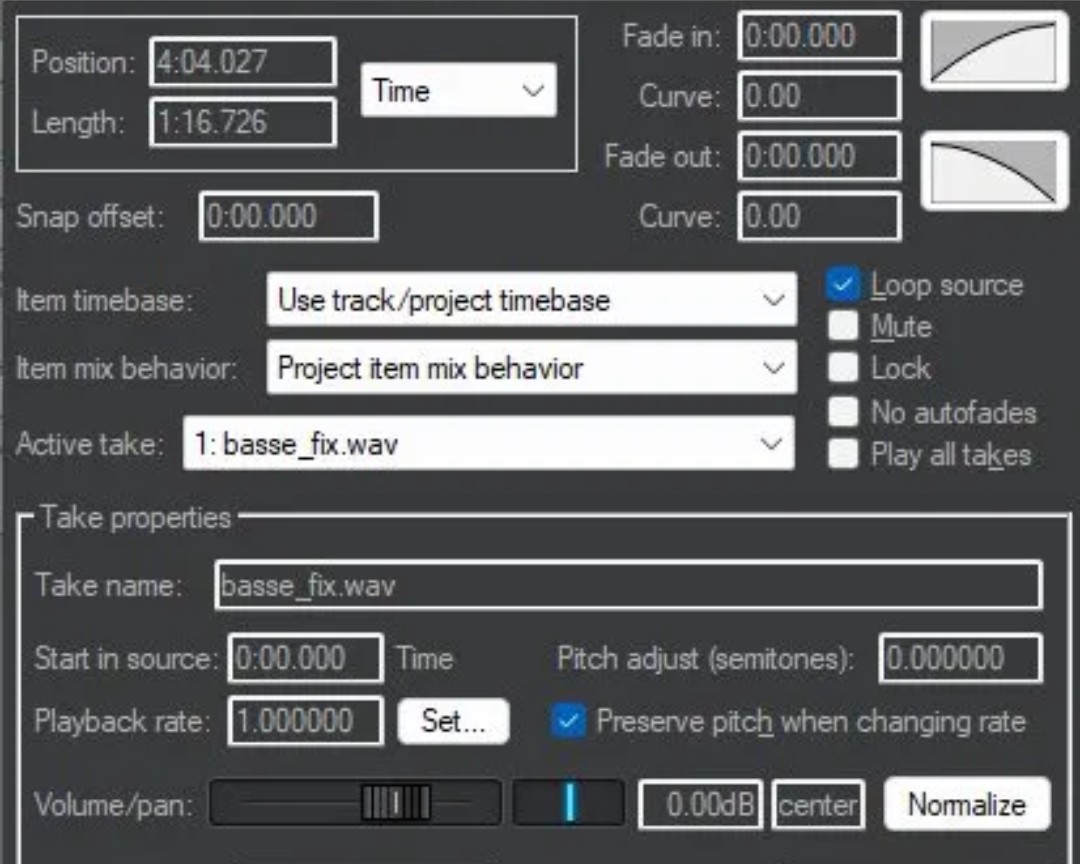
A Reaper export that nearly didn't
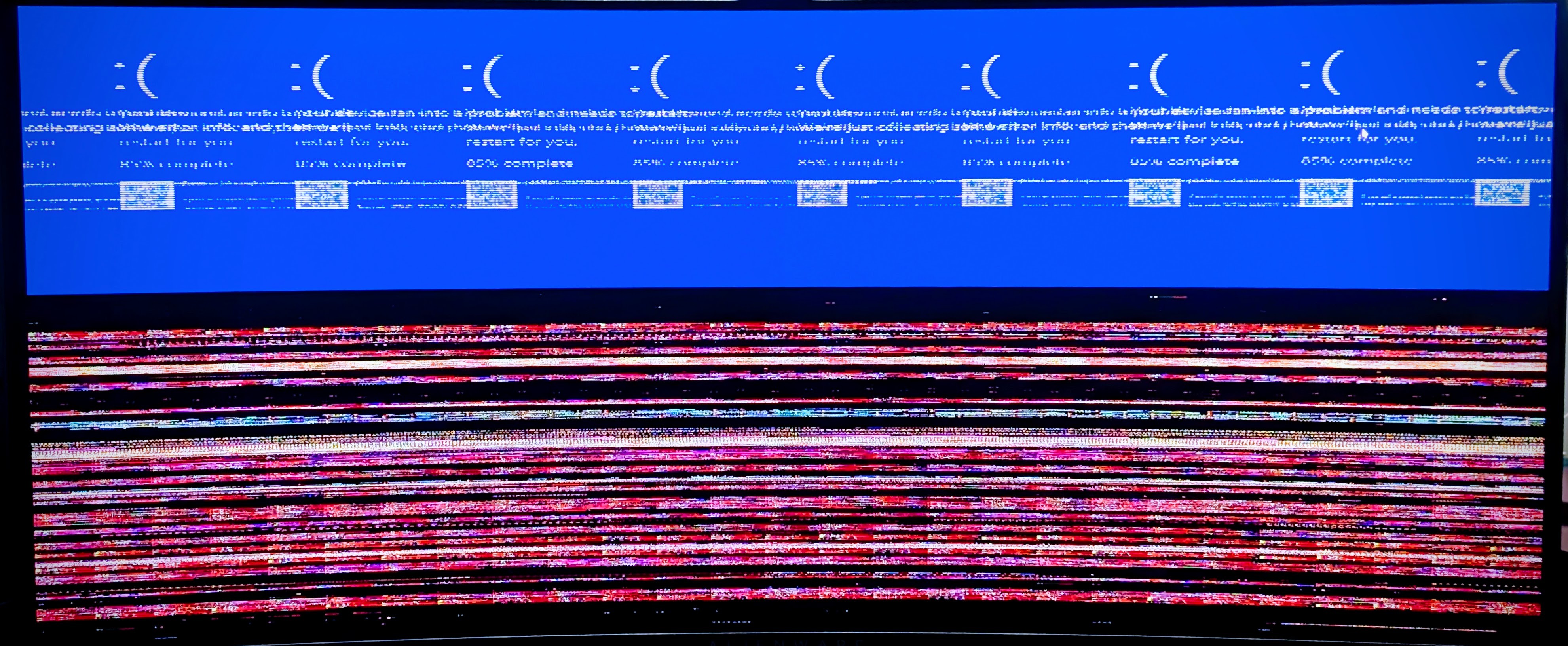
Isolating individual tracks manually, trying to find where the glitch was happening.May 17, 2026
The night everything was due... First, Reaper refused to render the master cleanly.
Offline rendering kept glitching MIDI notes in the final mix, so I
had to render in real time to get a usable audio file to overlay
onto the video in Premiere. However, footage looked perfect in
the Premiere preview but the
rendered MP4 came out blown out and oversaturated with crushed
contrast. The Xperia clips were shot in HLG (Rec. 2100), and the
export was inheriting that colorspace incorrectly. Re-exported in
Rec. 709, but a bunch of clips were still blown out and
completely over-exposed, so I had to go back and patch
hue/contrast across a lot of them. Another hour gone.
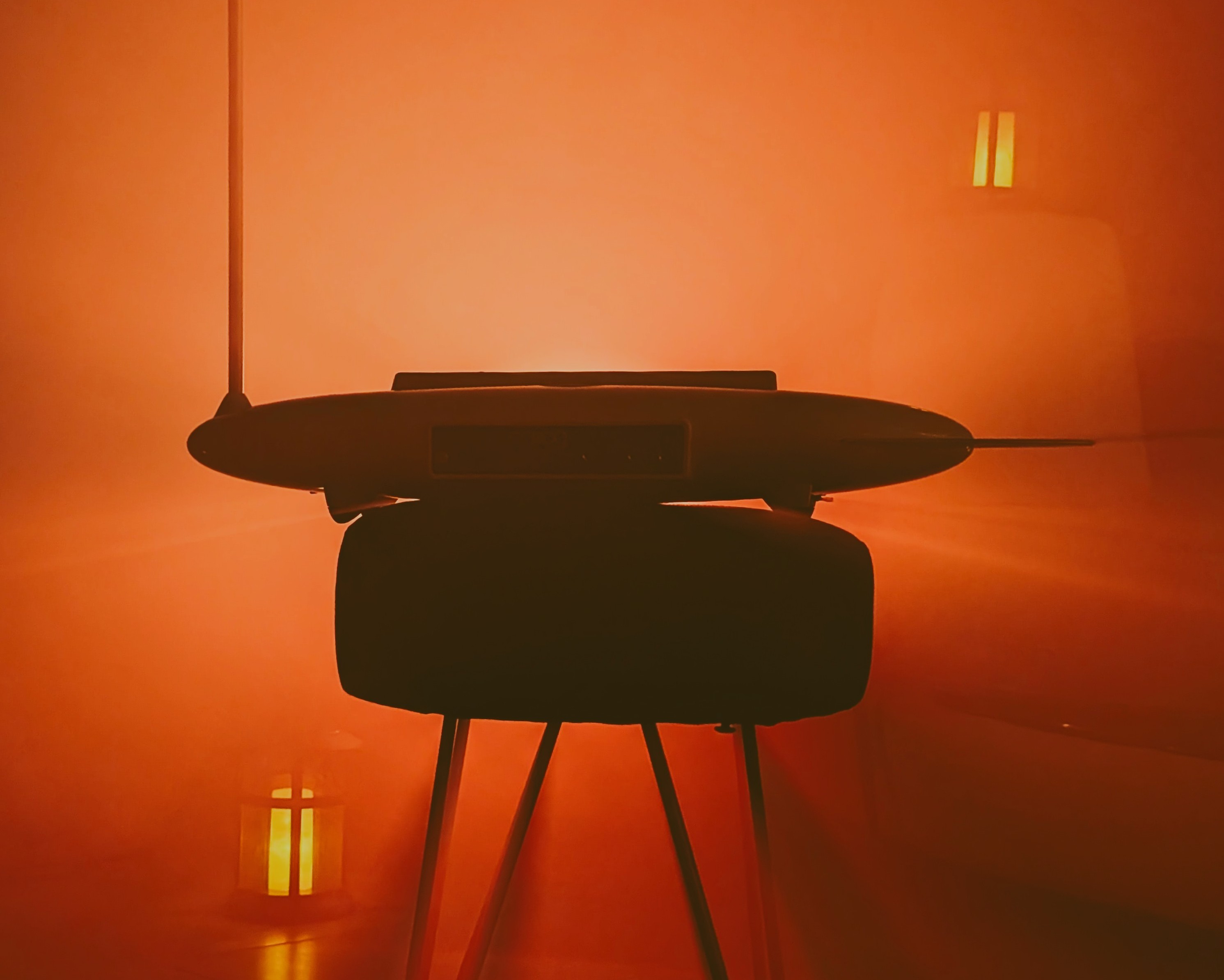
First fog machine run, instant regret
Theremin in the fog, ambient lanterns lit.April 24, 2026
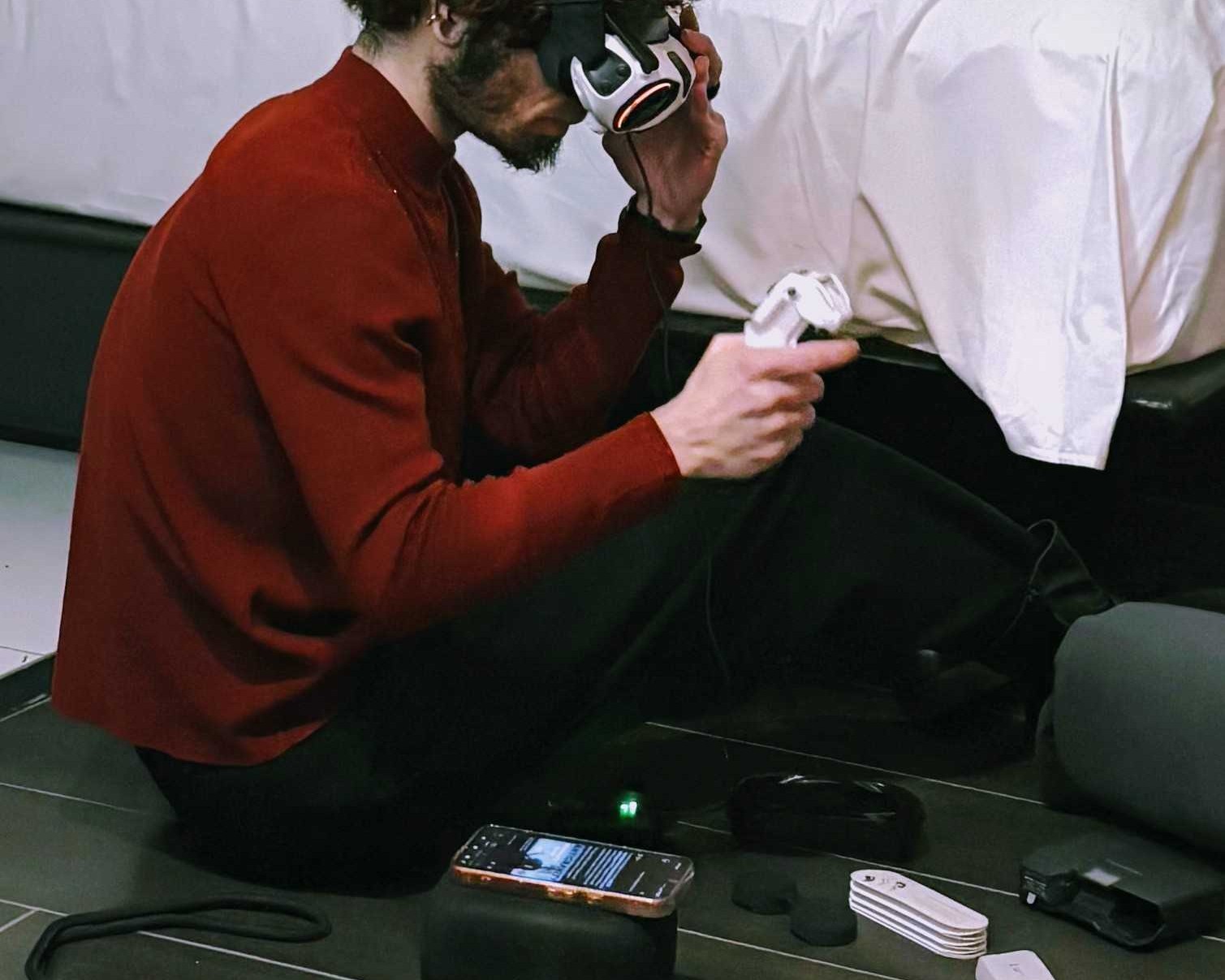
First time setting up and running the fog machine.
The chemical smell was horrendous. I had no idea what I
was getting myself into. Thank God I removed my smoke
detectors five years ago when I moved into this place,
otherwise I would have been in trouble. Pushed through
and got the takes.
May 13, 2026
Proxy footage saved the project
When I finally began editing in Premiere Pro at a quarter
timeline resolution and still hitting 100% CPU on a
32-core Threadripper every single time I dropped new
footage onto the sequence. Single edits took hours. Four
days before release I was genuinely worried the project
would miss the anniversary. I learned about proxy footage
and had to re-encode every clip
through Adobe Media Encoder. Hundreds of files, close to
half a terabyte of re-interpreted media, the job ran
overnight. After that Premiere finally played the timeline
in real time.
Setting up the drums and jamming out
April 6, 2026
Andrew came over to help me set up the Roland TD-27KV
after it arrived. Boxes everywhere. I was profoundly lost.
The frame was easily the most complicated part, we couldn't
get it aligned properly and spent hours fighting it.
Eventually I realized we were unintentionally assembling
it half on the left-handed instructions and the other half
of the time, referencing the original assembly
instructions. Ugh. It came together at some point and we
ended up just messing around with the kit's hundreds of
presets. First time I've ever played drums in my life.
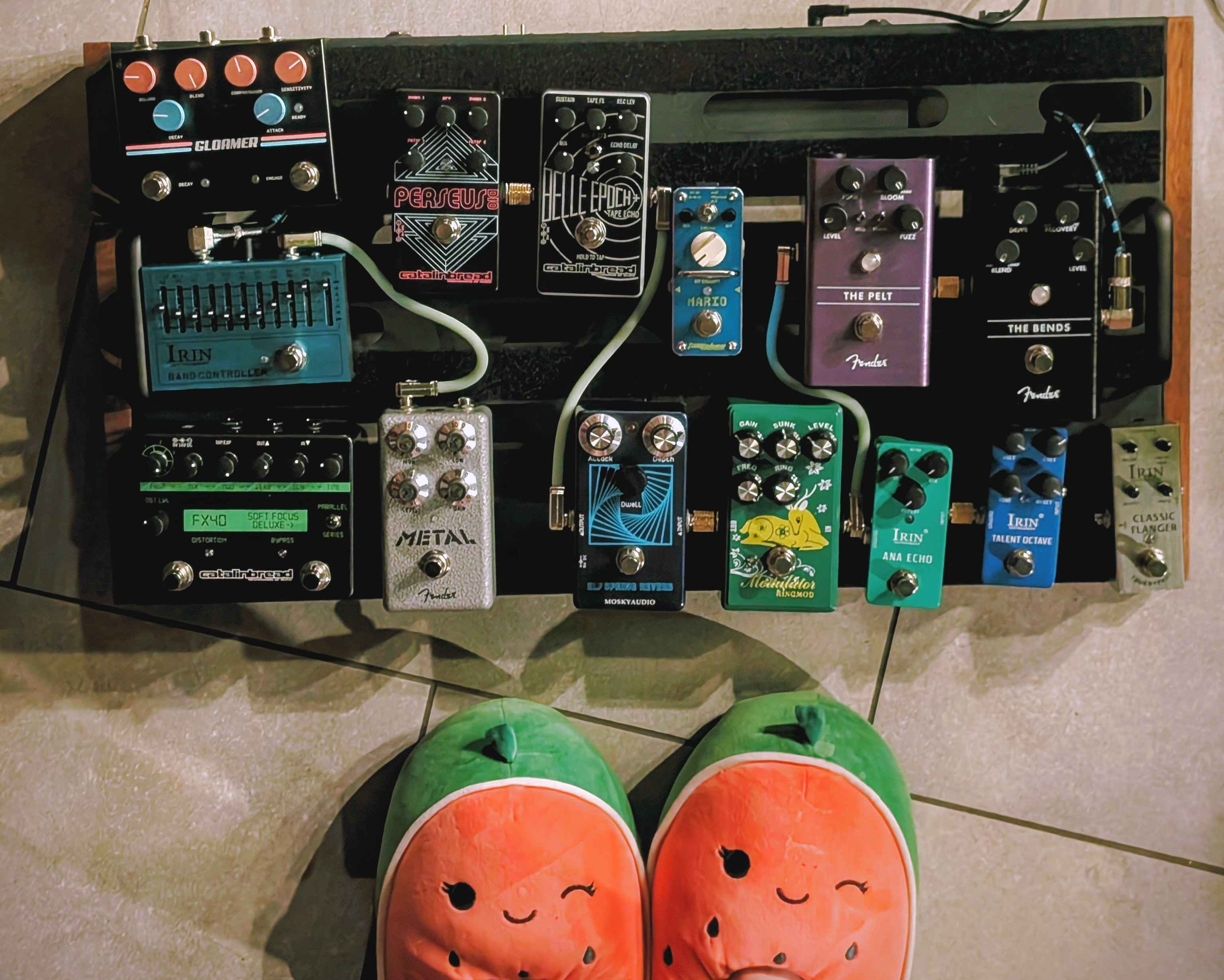
Afterwards we pulled out guitars and pedals and just
jammed. Andrew also handed me an amp he'd found on the
side of the road and restored himself.
Layaway at Guitar Center
April 6 to 22, 2026
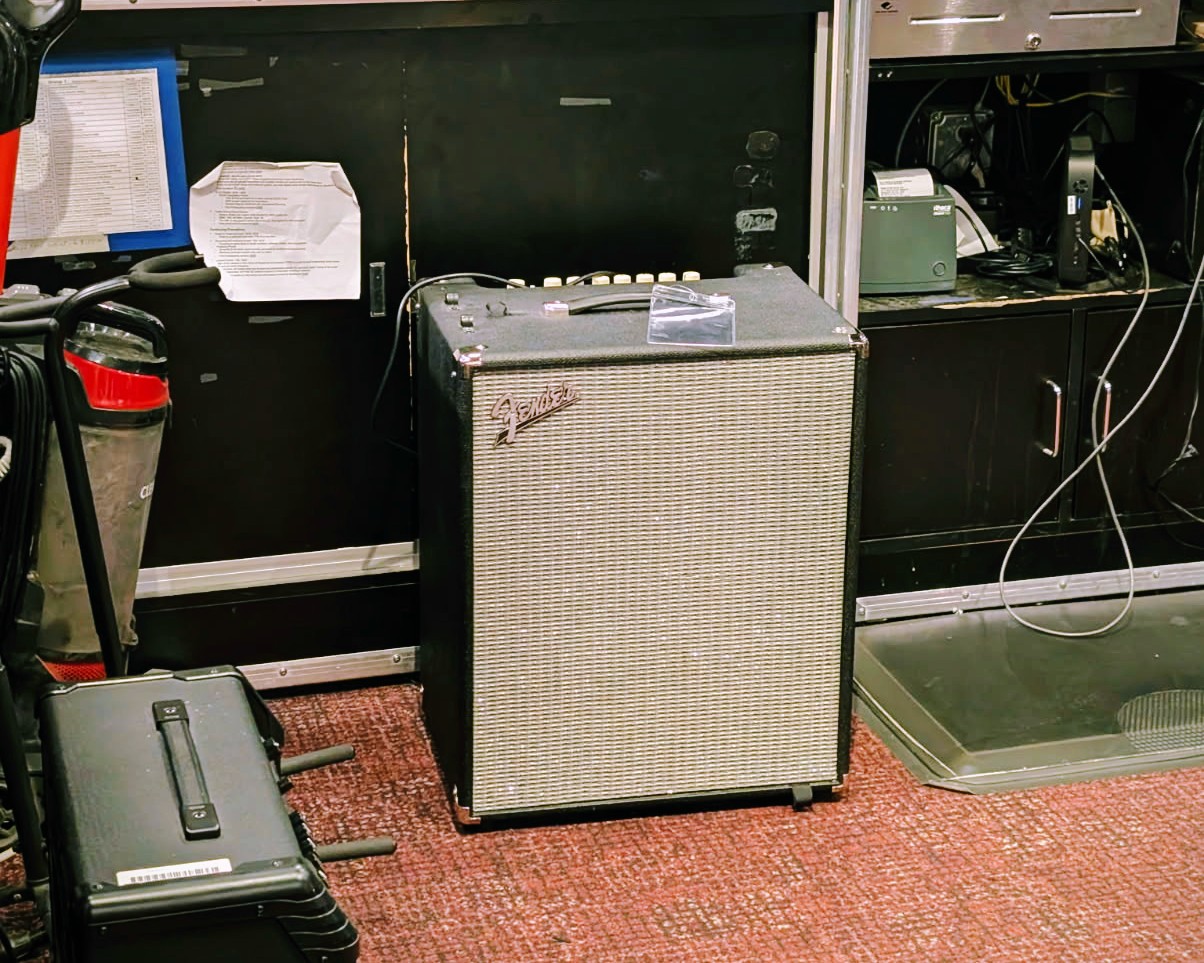
Went into Guitar Center on April 6 to buy the Fender Rumble 500
for the bass tracks. The store wouldn't let me walk out with it that
day. They put it on layaway and made me wait sixteen more days
before pickup, I think to give the window for any stolen-goods
report to surface. I was counting those days! Came back on the 22nd
to actually collect the amp. You BET I had fun with it immediately.
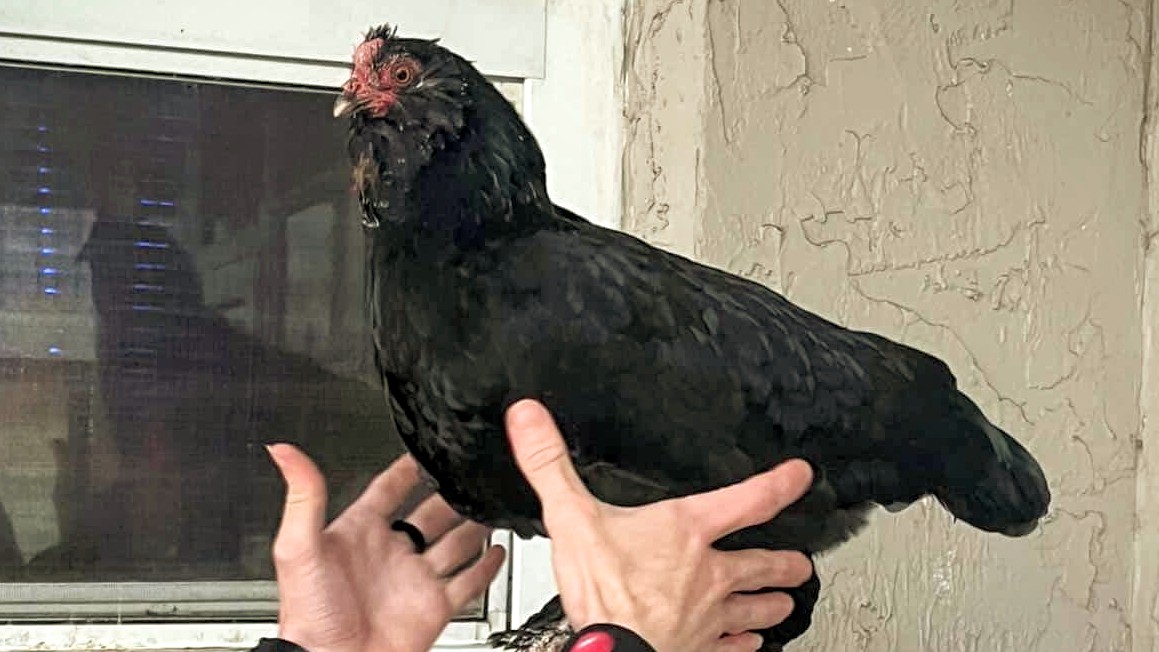
Home in Florida, first stop the chickens
This is Big Fat Meanie about to get a surprise hug from me.February 20, 2026
Arrived back in Florida on February 20. One of the
first things I did was go see my chickens.
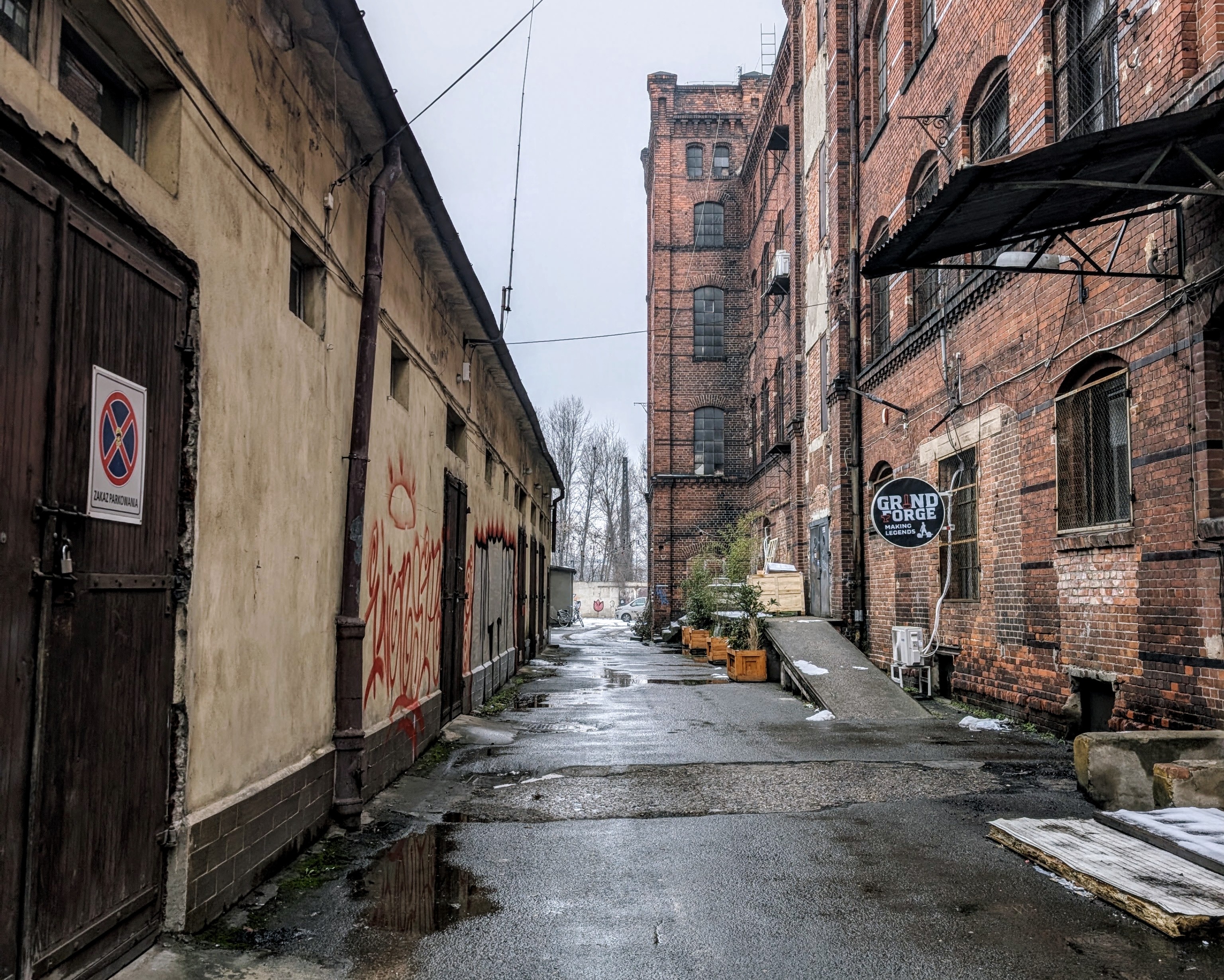
Back in Wrocław for a second stint of vocal lessons
The back alley, less frozen this time.February 18, 2026
So now I'm finally back in Wrocław, and I need to
wrap up my vocal lessons. This time, there's no snow.
And everything's a little mucky.
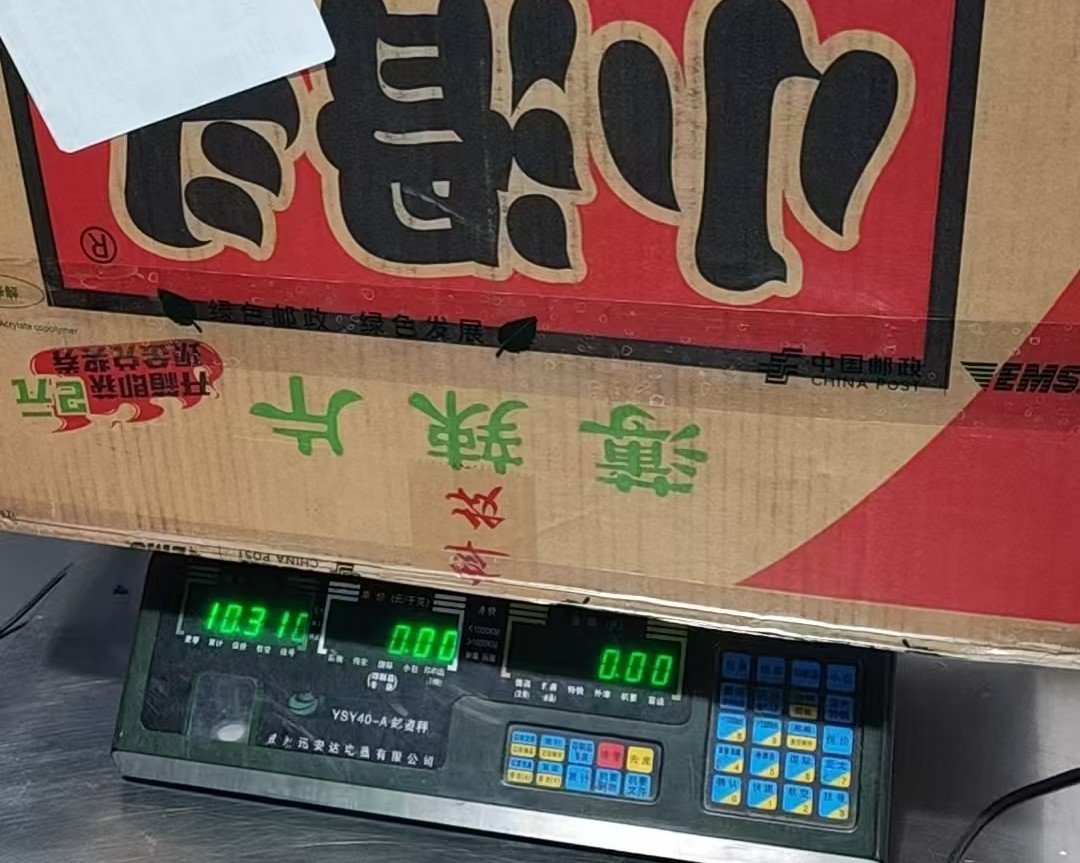
My mother flew back to Chongqing
February 16, 2026
Since I'd left my luggage back at my hotel in Chongqing
with the intention of shipping it directly back to Florida
(including the white outfit I'd worn for the Poland shoot),
the new US-China freight tariffs landed and shipping turned
cost-prohibitive; no carrier would
quote a workable rate. I convinced my mother to fly back and
spend the Chinese New Year in Chongqing again (but actually
as an excuse to pick up my luggage). She would hang onto it
until returning to the States. It ended up being cheaper to
send her back to China than to ship the luggage back home
to Florida.
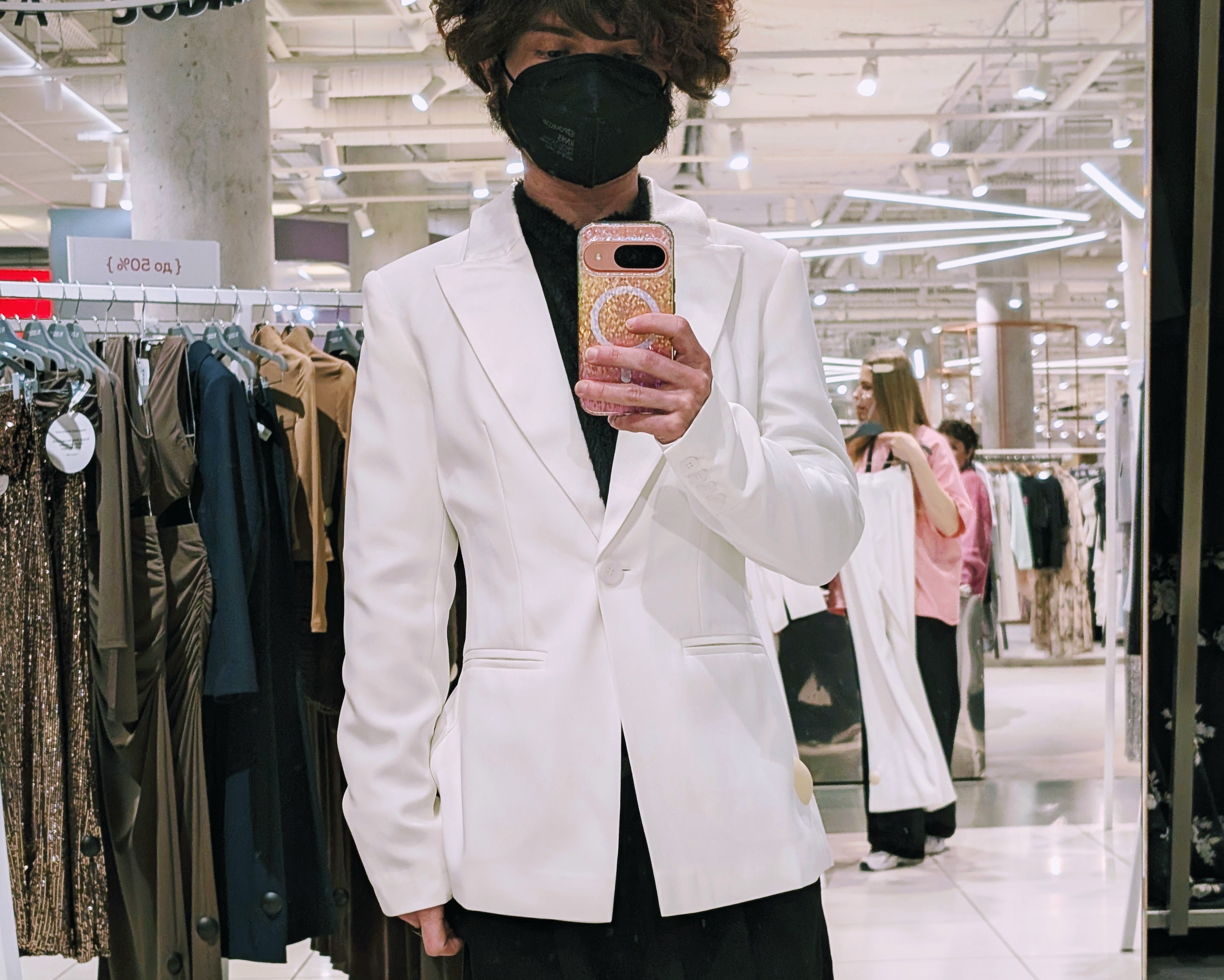
A jacket in Moscow
February 10, 2026
Routed through Moscow after Chongqing on the way home.
On February 10 I picked up a white designer jacket that
ended up in the interior shoot wardrobe. Last one they
had in my size, on clearance. How convenient! I needed a
white blazer...
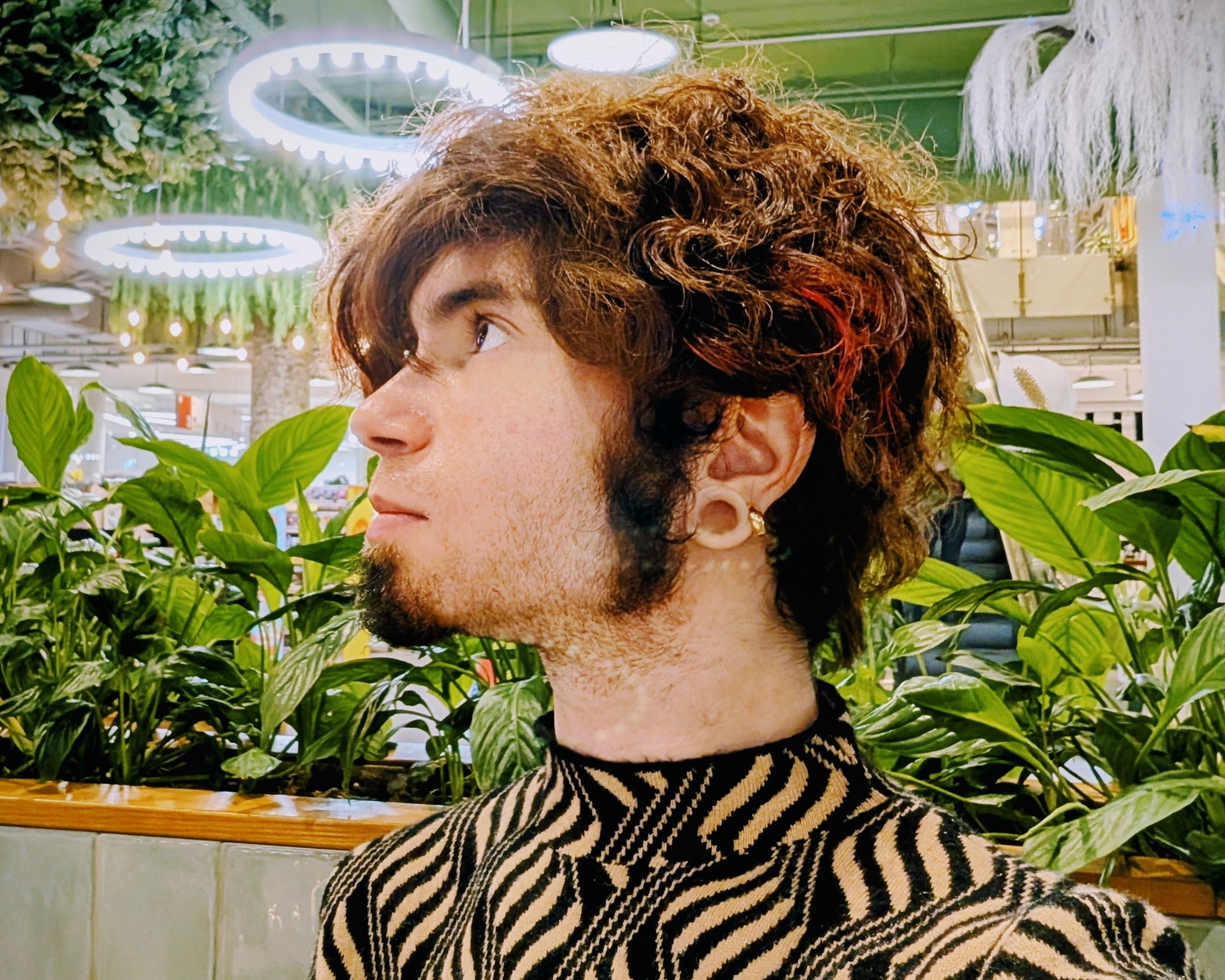
Growing the beard out
Early in the grow-out.February 9, 2026 onward
On February 9 I stopped shaving and started growing
my facial hair out for the interior shoot, so the
vocalist (the only performer with a fully visible face
in the cut) would read as the same person across every
multi-self composite. The grow-out ran more than two
months. Through the shoot window I dyed the beard black
roughly every other week to keep the color consistent
from take to take. My beard grows in bright ginger
thanks to the MC1R rs1805005 T:T variant (I'm the only
person in my extended family with any ginger hair at
all), so even a few days of regrowth at the edges would
have given the compositing away. One
$1.25 box of dollar-store dye got me about four
applications, which covered the whole run.
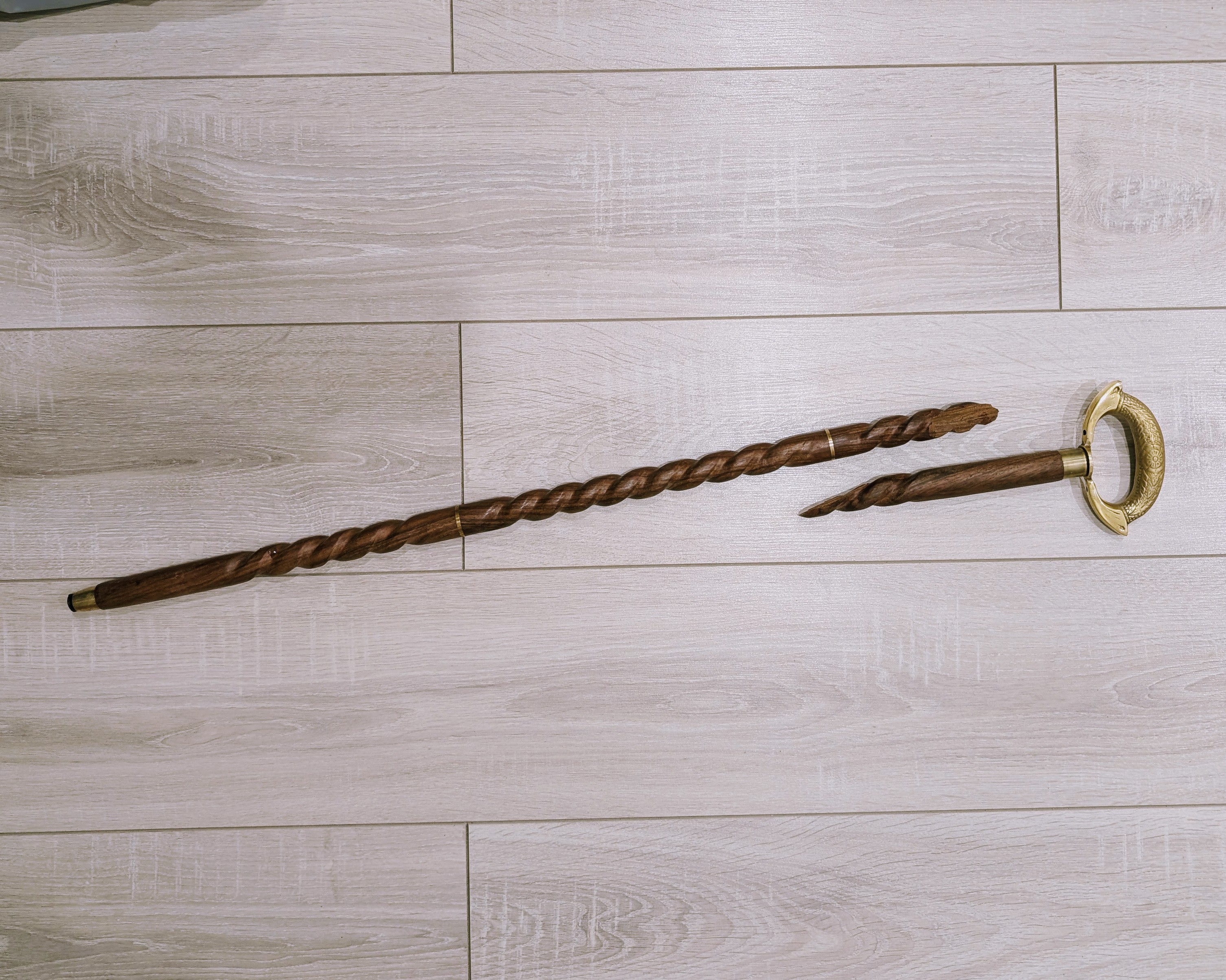
I broke another bone
February 4, 2026
The carved wooden cane I'd been walking with through the
trip gave up on February 4, the day after I'd landed in
Moscow. It snapped diagonally rather than straight across,
which turned out to be lucky: a clean perpendicular break
would have been almost impossible to wrap, but the
diagonal gave the tape something to grip. Fixed it on the
spot with the glue I happened to have in my carry-on plus
a really tight wrap of electrical tape, and the repair
held up the rest of the trip and through the interior
shoot back home.
Detained at the Moscow border
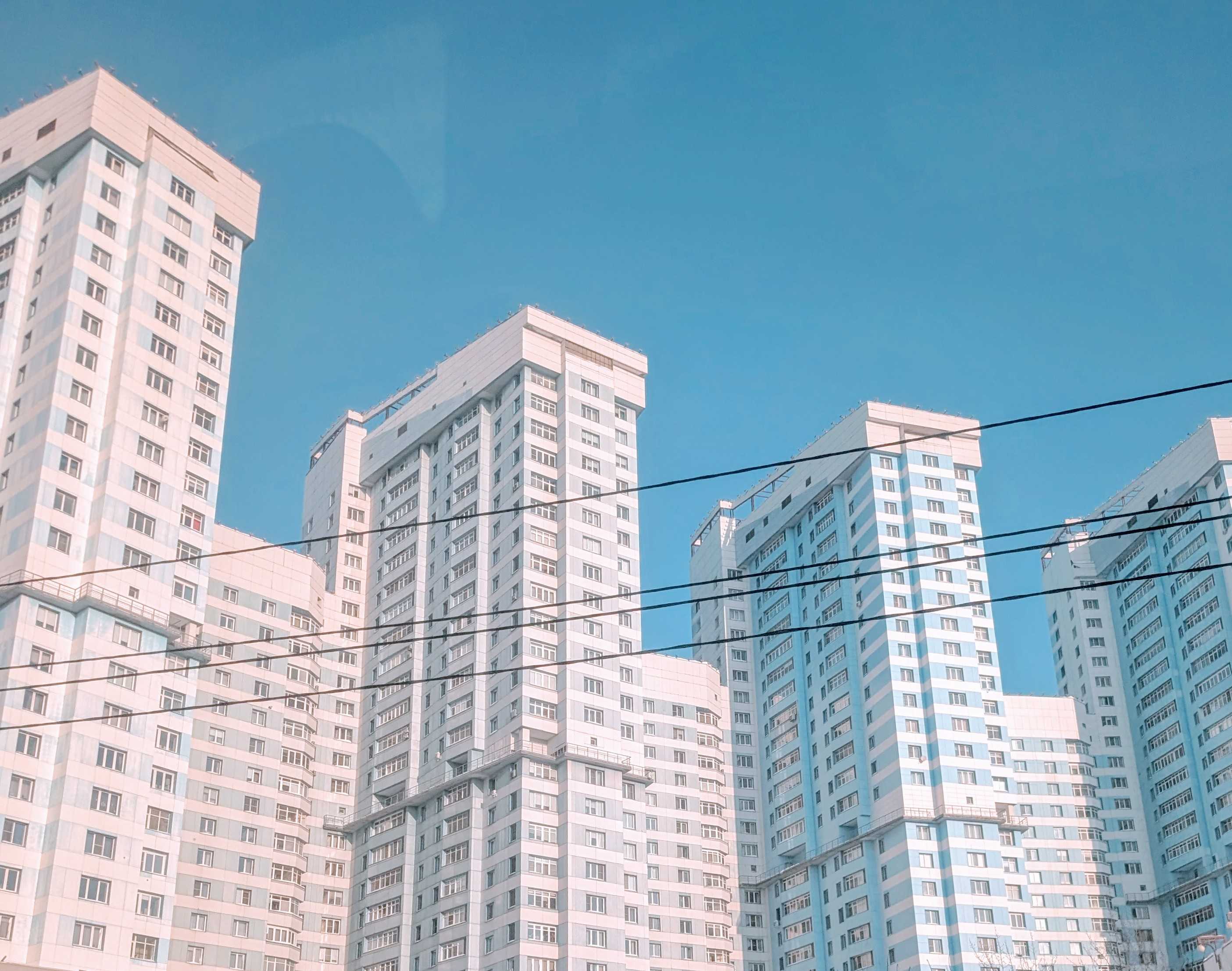
Are these buildings from Miami, or Moscow?February 3, 2026
Abu Dhabi was supposed to be my stop after China, but
with the Muse show cancelled there was no real reason to go,
so I rerouted to Moscow. I landed on February 3, my first
time back in the country in eighteen years. Border officers
pulled me aside almost immediately and walked me into a room
off the arrivals hall. Bad news, because there is a war I
was never drafted for. They grilled me for hours. At some point they
took my phone, walked it into another room, and brought it
back with a printed sheet of my call logs and what looked
like a year-deep scroll through my photo gallery. Hours
went by. They searched my luggage and found my Harvard student
ID card. After some more back and forth, they finally let
me go. I think it saved me.
Chongqing layover
Trying to navigate the drone menu, which is entirely in Chinese.Late January 2026
While still in Chongqing, I checked out the famous Ring
Mall and made a stop at the Insta360 shop. Grabbed the
Antigravity A1 (the 8K 360 drone Insta360
co-engineered) at full MSRP. It had literally just been
released. So naturally, I snagged it.
First days in Chongqing, with the cane
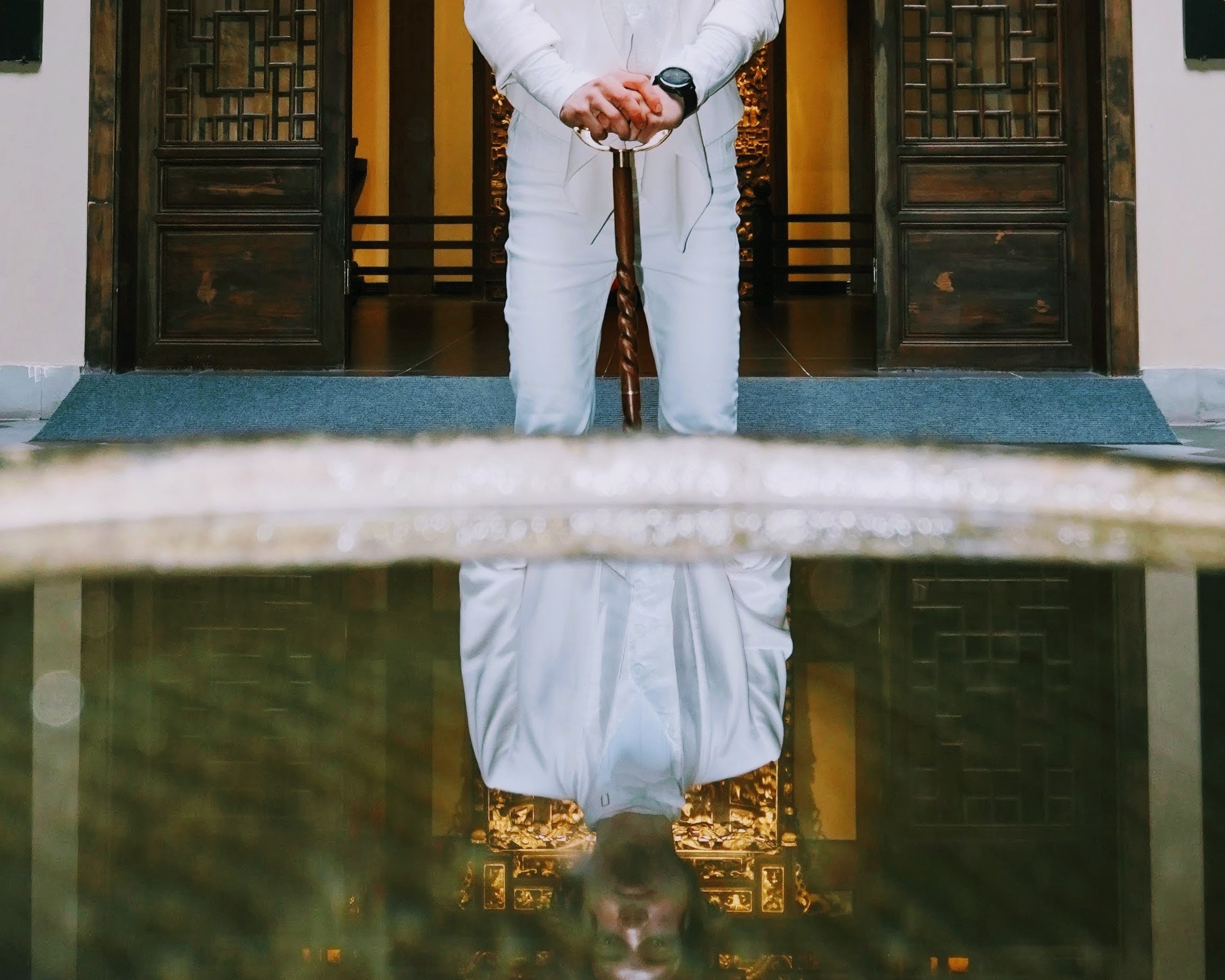
White outfit and cane, somewhere in Chongqing.January 23, 2026
Arrived in Chongqing on January 23. Spent the first
few days walking around the city doing professional
photoshoots in that same white outfit with my carved
wooden cane. The contrast against the dark wood, the water, and
the traditional Chinese architecture had absolutely
everyone turning their heads and snapping their own
photos lol.
The Muse Abu Dhabi show is cancelled
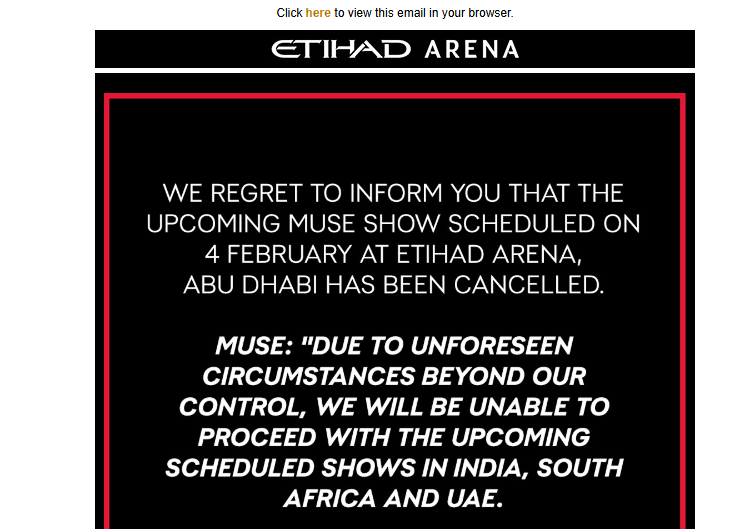
This is the email I received that morning.January 14, 2026
I'd booked tickets to see Muse at Etihad Arena in Abu
Dhabi on February 4, 2026, the plan being to catch them live
before starting work on this cover. Abu Dhabi was also going
to be my stop after China, with a few days planned around
the show. On January 14, Muse cancelled the date citing
unforeseen circumstances. A few weeks later, on February
28, Abu Dhabi was hit by
Iranian missile strikes during the US-Israel-Iran war,
including the area I'd booked a hotel in. Had the show gone
ahead I would have been there in the middle of it. Flights
were grounded across the region during the strikes and a
lot of people struggled to get out. The cancellation I was
disappointed about ended up being the reason I wasn't there
for any of it, and the reason I ended up in Moscow instead.
The coldest day of winter
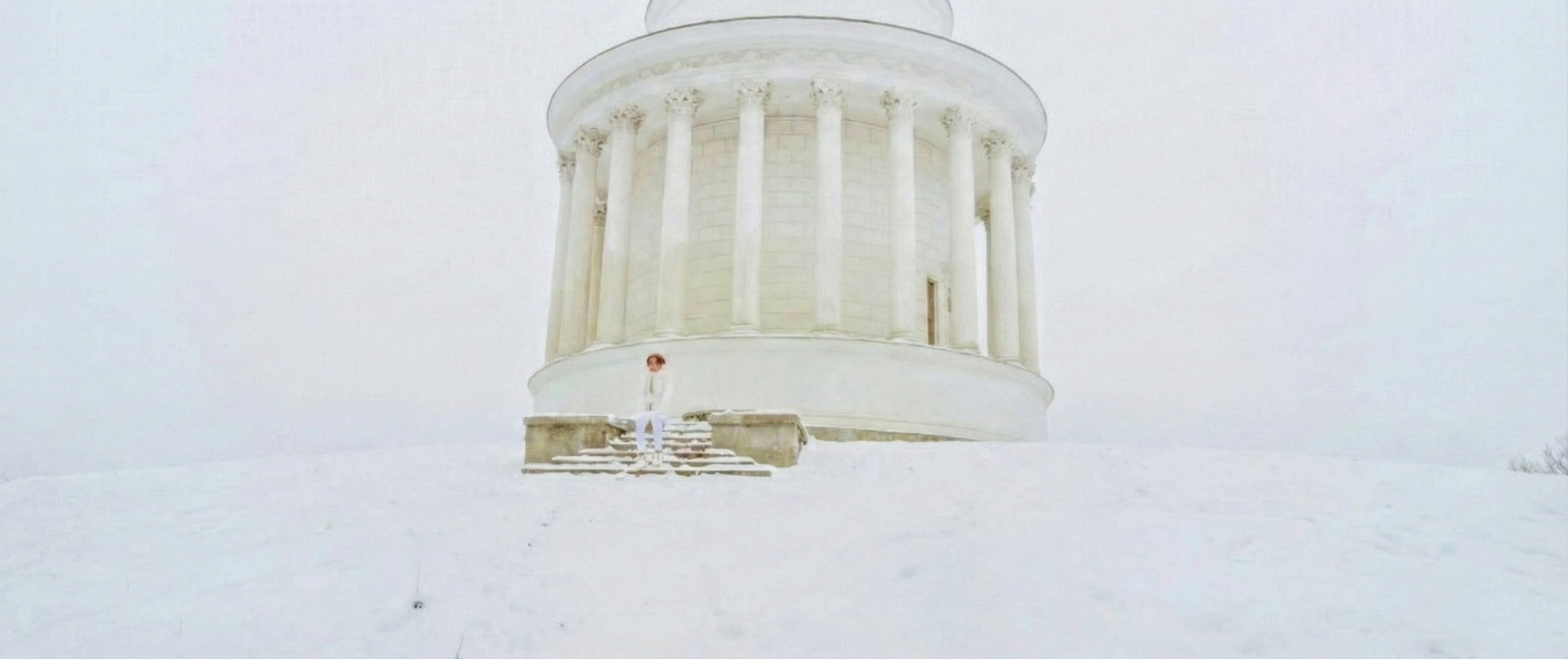
Temple of Vesta Water Tower, Warsaw.January 11, 2026
Most of the Polish exterior footage came from a single
shoot day, January 11, 2026, the coldest stretch of the
season, at the Temple of Vesta Water Tower
in Warsaw. The cold was record-setting. I was so lucky
to get the gorgeous snowfall here that we did. I could
see my own breath. Not a sight I ever get in Florida.
First vocal lesson, down a back alley
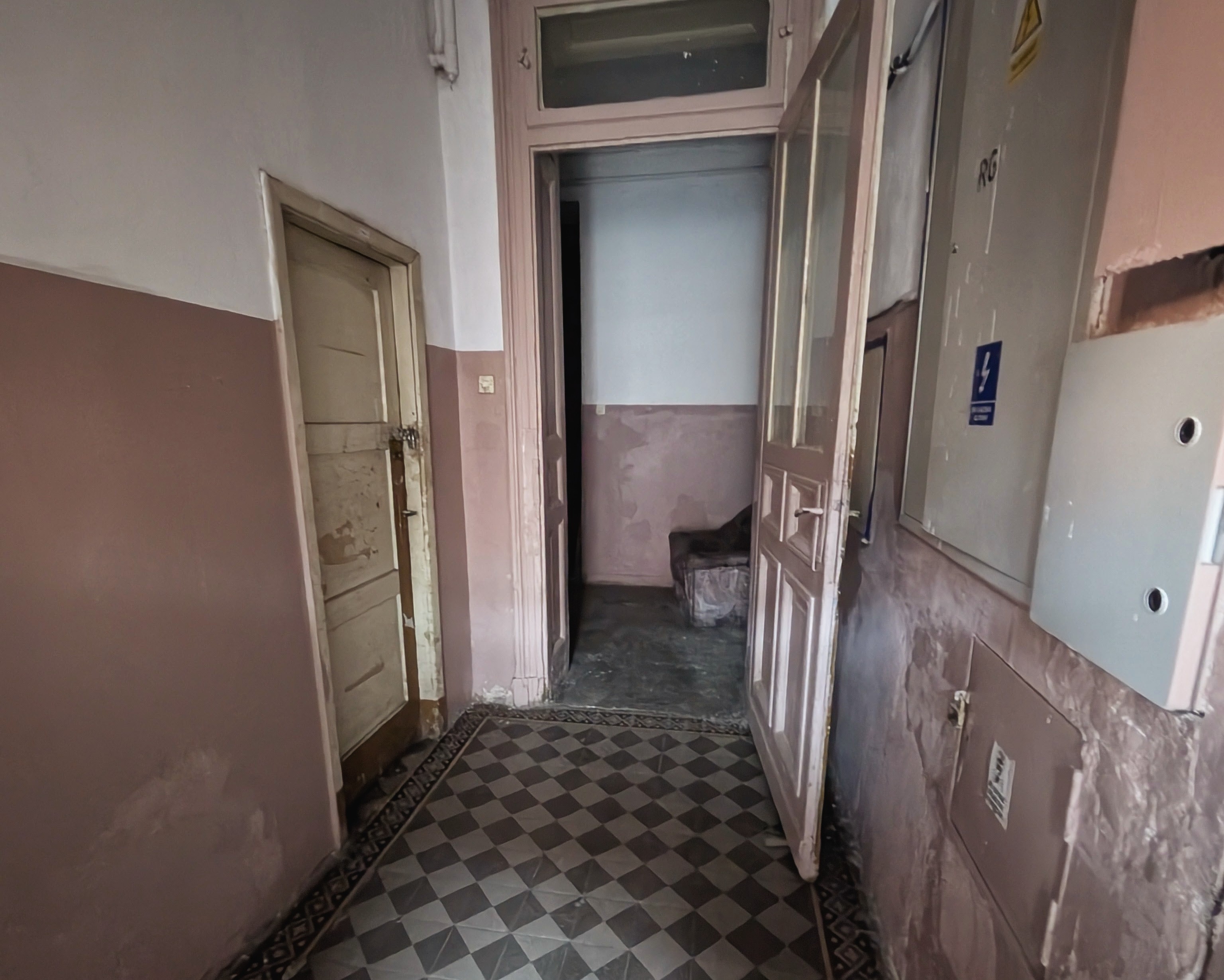
The hallway where I waited.December 27, 2025
First vocal lesson with Weronika. I underdressed for
the cold and couldn't find the entrance; it turned out
to be down a back alley I'd never been to before.
My instructor was running a bit late, so I waited inside a
dim hallway that was maybe a couple of degrees Celsius
warmer than the street. Just enough to keep my fingers
from completely numbing out before the door opened.
The idea, in bed
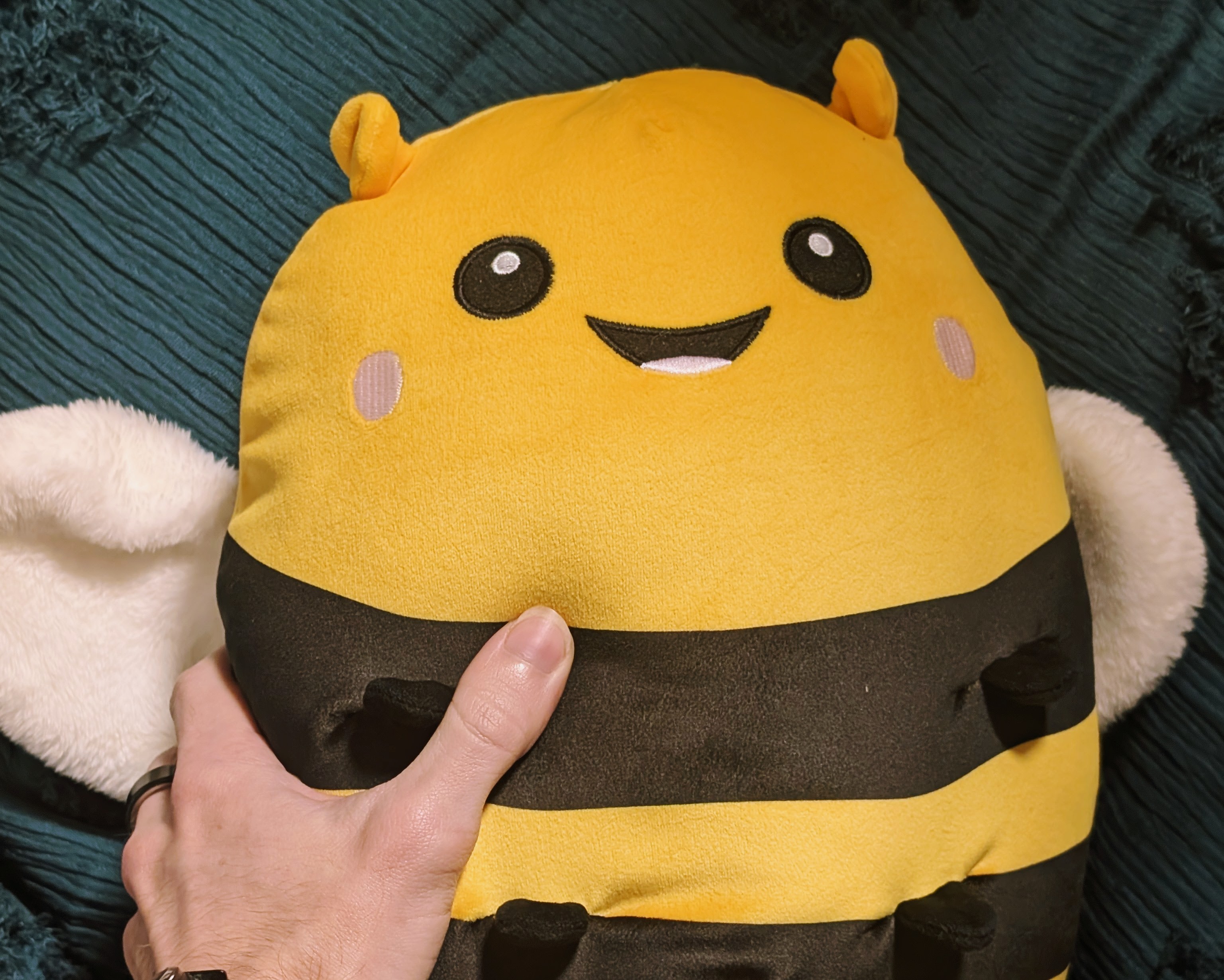
Happy Bee plushie, a Squishmallow. We were watching the music video together. This is how it all started.Late November 2025
About to put the phone down for the night, snuggled
with Happy Bee, when Sing for Absolution came
on. The song is so beautiful I assumed the official
music video had to match it. Looked it up and was
honestly disappointed: the space opera CGI doesn't do the
song the justice it deserves. Hence, the final pivot.
The Arrangement
Muse released "Sing for Absolution" on their third album,
Absolution, in 2003. The single followed
on May 17, 2004. This cover happens to release
on the same calendar date, twenty-two years later, a coincidence
I only caught mid-project. The original runs
4:54 in D minor at
86 BPM, with Matt Bellamy's lead vocal sitting
in the upper register (G3 to A4) over the standard four-piece
Muse lineup of vocals, guitar, bass, and drums.
The cover preserves the lyric and the key, and changes almost
everything else. Tempo drops from 86 BPM to
68 BPM. 68 is roughly the resting human
heartbeat, and at that pace the song stops sounding like a
rock track and starts sounding like a living thing. More
organic, more alive, with room for the chords and the breath
between phrases to do their work. The original now feels
rushed to me, too fast for what the lyrics are actually
saying. The lead vocal moves exactly one octave
below Bellamy's original line (also because there's
no way I could hit those notes).
I listened to Sing for Absolution 641 times across the project.
Per Spotify, end of project window.
Most of the new textures come from two instruments that don't
appear anywhere in the 2003 recording. A
theremin takes over the trailing synth lines.
The other is a Roland aerophone, a digital
wind controller, the kind of instrument where you blow into
a mouthpiece and pick from hundreds of presets rather than
producing a single acoustic sound. Re-compositing the song
around those two instruments was the part of the arrangement
I had the most fun with.
Production
Even my poor workstation could not always handle the grueling editing process.
Audio
Reaper held the whole session. I learned
it from scratch for this project. Vocals, full mix, track
alignment, comping, and final mastering all lived there.
Adobe Audition covered effects work and
noise reduction on tracked material before it bounced back
into Reaper for the mix.
Every instrument on the record was a first for me. Lead
vocal, drums, bass, theremin, aerophone, none of them on a
recording I'd released before. I can't read sheet music
either, so before tracking any of it I had to figure out
the notes by ear. I ran the original studio recording
through LALAL.AI to split it into isolated
stems, transcribed each line, and manually rebuilt every
instrument part as a MIDI track in Reaper. The MIDI told
me which notes to play and for how long. Then I tracked
each part live on the actual instrument, using the MIDI as
the reference. Everything you hear is a live take, but
every one of those takes was learned from the MIDI I'd
reconstructed for it by ear. At one point the session held
41 layered vocal takes before comping
back down to a final lead and harmony stack.
Video
Edited in Premiere Pro, also learned from
scratch for the capstone. Cross-cuts between the warm
interior performance and the cool Polish winter exterior.
Multi-self compositing built up directly in the timeline, so
the same person shows up as different versions across
costume, posture, and instrument.
For the interior look I wanted that dense, slightly-toxic
Blade Runner air sitting on every light source.
There was no clean way to fake it in post at the density I
needed, so I filled my house with practical fog. The room
was nearly uninhabitable for the shoot, but it's the reason
every warm-tone interior frame has real volumetric depth
instead of a plug-in approximation.
Lighting was practical too. A chandelier of Prince Rupert
drop crystals overhead carried the warm spill on the
vocalist; twelve battery-powered flame / candle lanterns
scattered around the room handled the ambient set glow.
The small warm pinpricks visible behind every interior
frame are them, indoors, not a post effect. The room's
Philips Hue ecosystem, already part of the house's IoT
setup, handled the broader ambient room lighting.
Technical specifications
Music
Key. D minor
Tempo. 68 BPM (down from the original 86 BPM)
Meter. 4/4
Lead vocal range. G2 to A3 (exactly one octave below Bellamy's original G3 to A4)
Stem extraction reference. LALAL.AI (used on the original recording to isolate parts for transcription)
Vocal microphone. Shure MV7
Instrument tracking. Tascam DR-40X, line-in from instruments with an adapter where applicable
Instruments tracked. Lead vocal; Roland TD-27KV electronic drums; Jackson JS Spectra Bass JS3; Roland AE-30 aerophone (covering keyboard harmony and a violin-preset line); Moog Theremini
Lead vocal take count. 41 layered takes at peak, comped to a final lead and harmony stack
Video production
NLE. Adobe Premiere Pro
Encoder. Adobe Media Encoder (used for proxy generation)
Primary camera. Sony Xperia 1 III
Aerial / 360. Antigravity A1 (8K 360)
Source color space. HLG, Rec. 2100
Delivery color space. Rec. 709
Source media footprint. Hundreds of clips, about half a terabyte worth
Edit workflow. Proxy footage for real-time timeline playback on a 32-core Threadripper
Lighting & effects (interior)
Volumetric atmosphere. FogWorx Extreme High Density fog juice
Key spill. Chandelier of Prince Rupert drop crystals overhead (chosen because they've taken falls without shattering)
Ambient set glow. Twelve battery-powered solar flame / candle lanterns
Ambient room lighting. Philips Hue ecosystem (pre-existing IoT, not a project line-item)
Distribution
Video platform. YouTube (video ID dBwMMhsPcP4)
Delivery resolution. 1080p (full HD)
Closed captions. Enabled by default on the YouTube embed
Release date. May 17, 2026 (22nd anniversary of the original single)
Budget
A rough accounting of what this cover cost to make. Existing
equipment and tools, as well as what I had to buy specifically
for this project, the trips for exterior shots, the software,
the specialized training, & everything and anything
threading in-between.
Prices below reflect current manufacturer MSRP so the list is useful as a sourcing reference. Where an item is discontinued or has no published MSRP, the price I paid is shown instead and flagged inline.
Instruments
Roland Aerophone Pro (AE-30)$1,499.99
Roland FP-30X digital piano$799.99
Roland TD-27KV Gen 2 V-Drums$2,799.99
Moog Theremini (discontinued)$223.68
Jackson JS Spectra Bass JS3 (Snow White)$279.99
Fender Rumble 500 bass amp$799.99
Subtotal$6,403.63
Audio
Shure MV7 microphone (silver; MV7+ now replaces at $279)$249.00
Vintage microphone + stand$101.35
TASCAM DR-40X field recorder$229.99
Behringer HA-400 headphone amp$39.99
SanDisk Ultra 128GB SDXC (140 MB/s, UHS-I Class 10; used in the field recorder)$19.99
FogWorx Extreme High Density fog juice (1 gallon; used for the interior shoot atmosphere)$34.99
Solar flame / candle lanterns (12 units; $50 per 4-pack × 3)$150
Subtotal$200.25
Summary
Instruments$6,403.63
Audio$664.32
Camera gear$3,505.97
Costume$646
Travel$6,754.31
Software$299.97
Effects & accessories$200.25
Total$18,474.45
Acknowledgments
Original song "Sing for Absolution" written by Matthew Bellamy,
Christopher Wolstenholme, and Dominic Howard. Performed by Muse, from
the album Absolution (2003).
Industry collaborators
Vocal instruction by Weronika Ogonowska
(@vocalverse_studio),
a Wrocław-based soprano and voice coach. I took my first
vocal lessons with her in Wrocław: a first round around
Christmas 2025, and a few more in mid-February 2026 after
I came back from Moscow. What she taught me set the floor
for the lead vocal on this record.
Videography and instrument-learning support by
Andrew David Jewett
(@andrewsrqfl).
Andrew came over several times across the project: he helped
me assemble the edrums when they arrived, we jammed on
guitars and pedals together, and on a later visit he sat
down with me and helped me figure out the drum beat I'd
been stumped on. We also ran a few guitar and bass sessions so
I'd get comfortable playing before tracking.
On-set support
Co-shooting and on-set support in Warsaw by
Joseph Awuah-Darko
(@okuntakinte),
a Ghanaian artist. He joined me for the January shoot days and
helped me capture several of the snow exterior shots that
ended up in the final cut.
Special thanks
To my Harvard University instructors,
Alexandra Seckar-Bandow and
Shais Khan, for allowing me to pivot my
capstone idea last minute and letting me run with this
music cover.
And to the
r/Muse
community on Reddit, a passionate bunch and a constant
source of inspiration throughout this project.
 April 6, 2026
 April 6 to 22, 2026
 February 16, 2026
 February 10, 2026
 February 4, 2026